 Pumps
PumpsA05 vs A07 High Chrome: Which Impeller Material is Right for Your Mine?
Published June 12, 2026 · By Coolair Group Engineering · 10 min read
Choosing the right impeller material is one of the most consequential decisions in slurry pump maintenance. Get it wrong, and you'll face premature wear, unexpected failures, and skyrocketing replacement costs. Get it right, and you'll optimize your pump's service life while keeping total cost of ownership under control.
The two dominant high-chrome white iron materials for slurry pump impellers are A05 (27% Chromium) and A07 (15% Chromium / 3% Nickel). While they share a family resemblance, their metallurgical properties create dramatically different performance profiles in the field. This guide provides the technical depth you need to make the right choice for your specific mining application.
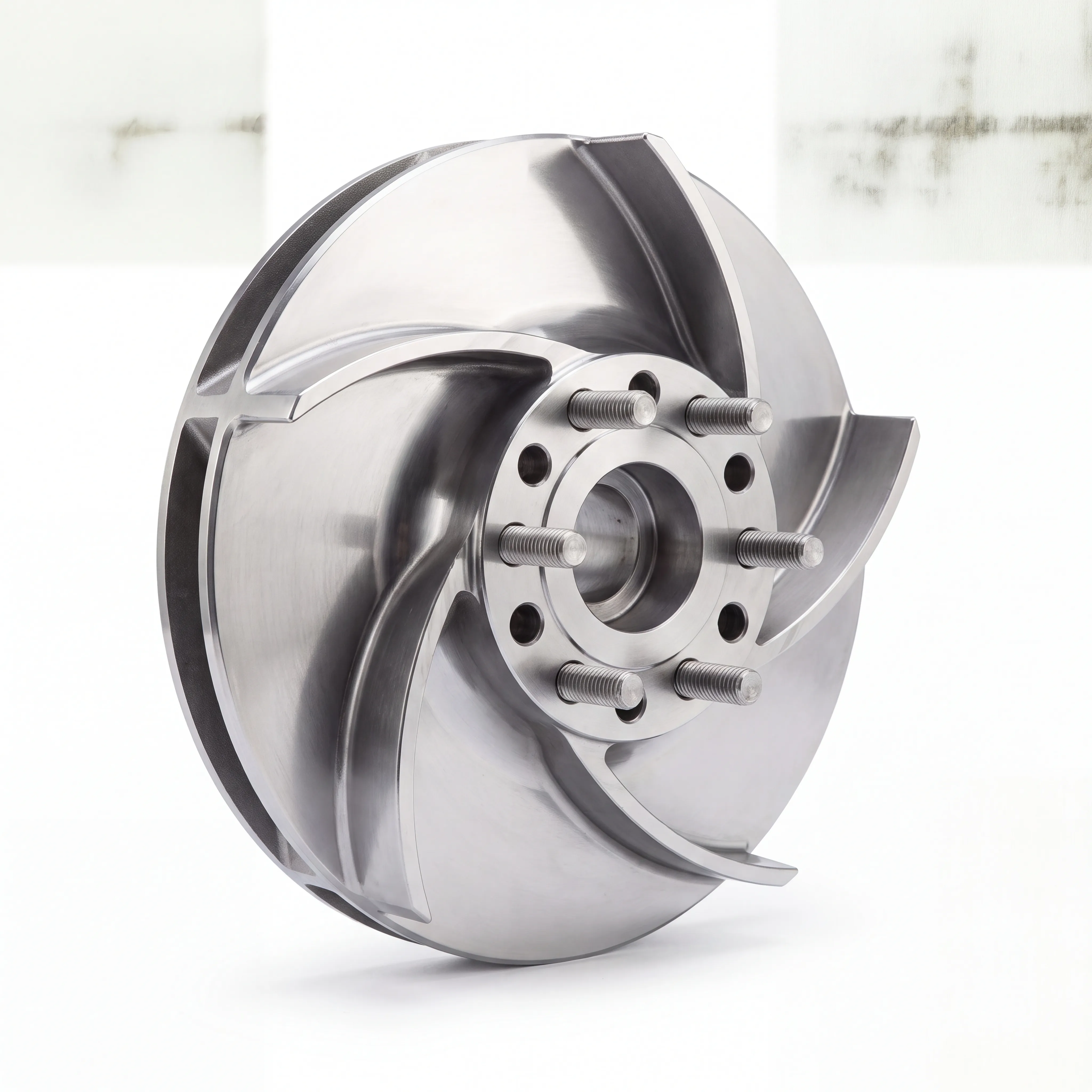
Understanding the Metallurgy
A05 — 27% Chromium White Iron
A05 is the industry workhorse for slurry pump wetted parts. Its microstructure features a dense network of M7C3 chromium carbides embedded in a martensitic iron matrix. This carbide network provides exceptional hardness and outstanding resistance to sliding abrasion — the primary wear mechanism in most mining slurry transport systems.
The high chromium content also delivers reasonable corrosion resistance in neutral to alkaline slurries (pH 7-12). However, the same hard carbide network that provides wear resistance also makes A05 relatively brittle. Under impact loading, sudden pressure changes, or thermal shock, A05 impellers can crack catastrophically.
A07 — 15% Chromium / 3% Nickel Iron
A07 is a modified white iron designed to address A05's toughness limitations. The reduced chromium content (15% vs 27%) produces smaller, more evenly distributed M7C3 carbides. The addition of 3% nickel promotes a tougher austenitic-martensitic matrix that absorbs impact energy far better than A05's purely martensitic structure.
The trade-off is clear: A07 sacrifices approximately 20% of A05's hardness in exchange for significantly improved impact toughness, thermal shock resistance, and corrosion performance in acidic environments.
Technical Comparison Table
| Property | A05 (27% Cr) | A07 (15% Cr / 3% Ni) |
|---|---|---|
| Chemical Composition | 27% Cr, 1.2% C, 0.5% Mn, 0.5% Si | 15% Cr, 3% Ni, 1.2% C, 0.5% Mn |
| Brinell Hardness (BHN) | 580–650 | 450–520 |
| Rockwell Hardness (HRC) | 60–65 | 47–53 |
| Microstructure | M7C3 carbides in martensite | Smaller M7C3 carbides in austenitic-martensite |
| Abrasion Resistance | ★★★★★ Excellent | ★★★★☆ Very Good |
| Impact Toughness | ★★☆☆☆ Low | ★★★★☆ Good |
| Corrosion Resistance | ★★★☆☆ Moderate (pH 7-12) | ★★★★☆ Good (pH 4-10) |
| Thermal Shock Resistance | ★★☆☆☆ Low | ★★★★☆ Good |
| Cost (Relative) | Baseline | 5–10% higher |
| Typical Wear Life | 3,000–5,000 hours | 2,500–4,000 hours |
| Max Operating Temperature | 90°C | 110°C |
Application Guidelines by Mining Sector
Gold Mining
Gold operations present diverse slurry conditions across the processing chain:
- Crushing and grinding circuits — A05 recommended. Neutral pH, high abrasion, steady-state operation.
- CIL/CIP carbon-in-leach — A07 preferred. Alkaline cyanide solution (pH 10-11), moderate abrasion, some chemical attack risk.
- Heap leach transfer — A07 required. Acidic lixiviant (pH 1-3), thermal cycling, potential for coarse particle impact.
- Tailings disposal — A05 recommended. Neutral to slightly alkaline, high volume, sliding abrasion dominant.
Copper Mining
- Mill discharge — A05 recommended. High abrasion, neutral pH, steady flow conditions.
- Cyclone feed — A05 recommended. Concentrated abrasive slurry, minimal impact.
- Flotation circuit — A07 preferred. Chemical reagents, variable pH (4-9), moderate abrasion.
- Concentrate transfer — A07 preferred. Higher density slurry, potential for particle settling and impact.
Iron Ore Mining
- Slurry pipeline transport — A05 recommended. High abrasion, long-distance steady flow, neutral pH.
- Dredge pumps — A07 preferred. Variable particle sizes, occasional coarse material, impact risk.
- Wash plant circuits — A05 recommended. High water-to-solids ratio, moderate abrasion, neutral pH.
Coal Mining
- Coal preparation plant — A05 recommended. Moderate abrasion, alkaline process water, steady operation.
- Slurry pipeline — A05 recommended. Long-distance transport, consistent conditions.
- Dewatering circuits — A05 recommended. Low solids, moderate abrasion, neutral pH.
Decision Framework
Use this step-by-step framework to select the optimal material:
- Is the slurry pH below 6? → A07 (superior corrosion resistance in acidic conditions)
- Does the slurry contain particles larger than 2mm? → A07 (better impact resistance for coarse material)
- Does the pump experience frequent start/stop cycles? → A07 (thermal shock resistance)
- Is the slurry temperature above 80°C? → A07 (higher thermal tolerance)
- Is sliding abrasion the primary wear mechanism in neutral/alkaline slurry? → A05 (maximum wear life)
- Is cost-per-hour the primary metric? → Calculate both: A05's 20-40% longer life in pure abrasion may offset its lower toughness cost advantage
Field Performance Data
Based on performance data from over 200 mining operations across 15 countries:
| Application | A05 Avg Life | A07 Avg Life | Winner |
|---|---|---|---|
| Tailings pipeline (alkaline) | 4,200 hrs | 3,100 hrs | A05 (+35%) |
| Cyclone feed (copper) | 3,800 hrs | 3,400 hrs | A05 (+12%) |
| CIL circuit (pH 10.5) | 3,500 hrs | 3,600 hrs | A07 (+3%) |
| Heap leach transfer (pH 2) | 1,800 hrs | 3,200 hrs | A07 (+78%) |
| Dredge pump (mixed particles) | 2,400 hrs | 3,000 hrs | A07 (+25%) |
| Mill discharge (iron ore) | 4,000 hrs | 2,800 hrs | A05 (+43%) |
| Flotation feed (copper) | 3,200 hrs | 3,400 hrs | A07 (+6%) |
Mixing Materials: The Hybrid Strategy
Many operations achieve optimal results by using different materials for different pump components. The most common hybrid approach:
- A05 impellers — withstand the highest velocities and abrasion within the pump
- A07 volute liners — handle the impact forces from slurry direction changes and the higher corrosion exposure at the discharge
- A05 back liners — experience primarily sliding abrasion similar to impellers
This strategy optimizes both wear life and reliability while managing overall material cost. The impeller-volute combination should always be selected together to ensure metallurgical compatibility.
Important: Always consult with your pump manufacturer or parts supplier before mixing materials. Galvanic corrosion between dissimilar metals can occur in certain slurry conditions, particularly in acidic environments.
Material Certification
Regardless of which material you choose, material certification is essential. Every impeller we supply comes with:
- Spectroscopy report — confirms chemical composition meets ASTM A532 Class II Type A (A05) or equivalent specifications
- Hardness test certificate — Brinell hardness verified at multiple points on the casting
- Microstructure analysis — carbide distribution and matrix structure confirmed through metallographic examination
- Dimensional inspection — critical dimensions verified against OEM drawings
Cost Optimization Analysis
The true cost of an impeller isn't its purchase price — it's the total cost per operating hour. Consider this example:
| Factor | A05 Impeller | A07 Impeller |
|---|---|---|
| Purchase price | $1,000 (baseline) | $1,050 (+5%) |
| Expected service life | 4,000 hours | 3,200 hours |
| Cost per operating hour | $0.25 | $0.33 |
| Unplanned downtime risk | Low (steady state) | Low (steady state) |
| Best choice | A05 — lower cost per hour in pure abrasion | |
But in acidic or high-impact applications, the calculation flips dramatically — A07's extended life under those conditions can reduce cost per hour by 40-60%.
Conclusion
Neither A05 nor A07 is universally superior. A05 is the cost-effective champion in high-abrasion, neutral-pH, steady-state applications. A07 is the reliability leader in corrosive, high-impact, or thermally challenging environments. The right choice depends entirely on your specific operating conditions.
At Coolair Group, we stock both materials and our engineering team can analyze your operating data to recommend the optimal impeller material. Every order includes full material certification and compatibility documentation for your specific pump model.
Related Products
Need Help Choosing the Right Material?
Send us your application details and we'll recommend the optimal material with full certification.
Contact Our Engineers →